
On the back of rising crude oil purchases, India's bill for imports from sanctions-hit Russia jumped 3.5 times in a year in April to $2.3 billion, showed data from the commerce ministry. In April, India's crude oil imports from Russia were valued at $1.3 billion, 57 per cent of India's total inbound shipments from Russia. Other major imported items during the month included coal, soybean and sunflower oil, fertilisers, and non-industrial diamonds. That month, Russia was also the fourth-largest crude petroleum supplier to India, after Iraq, Saudi Arabia, and the United Arab Emirates (UAE).

The capsizing MSC Chitra is located just a few kilometres from Sassoon Dock, one of Mumbai's largest seafood docks. Seafood prices are starting to fall there.
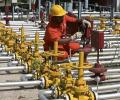
The government on Thursday hiked by 62 per cent the price of natural gas that is used to produce electricity, make fertilisers and turned into CNG to use as fuel in automobiles and cooking gas for household kitchens. This is the first increase in rates since April 2019 and comes on back of firming benchmark international prices but does not reflect the spurt in spot or current price of liquefied natural gas (LNG) witnessed during the last couple of weeks. The oil ministry's Petroleum Planning and Analysis Cell (PPAC) said the rates paid for gas produced from fields given to state-owned Oil and Natural Gas Corporation (ONGC) and Oil India Ltd (OIL) will be $2.90 per million British thermal unit for the six-month period beginning April 1.

Fitch Ratings on Monday said uncertainty over the bidder consortiums and process complexity, including valuation, may lead to potential delays in privatisation of India's second-largest fuel retailer, Bharat Petroleum Corporation Ltd (BPCL). Affirming BPCL's rating at 'BBB-' with a negative outlook, Fitch said it continues to treat the potential divestment of the company by the Indian government as an event risk. "Bidders are conducting due diligence, but uncertainty over the bidder consortiums and process complexity, including valuation, may lead to potential delays.

The rupee depreciated by 37 paise to close at 79.62 against the US dollar on Thursday despite sustained foreign capital inflows and a positive trend in equities. At the interbank foreign exchange market, the local currency opened at 79.22 and saw an intra-day high of 79.22 and a low of 79.94 against the American currency. It finally ended at 79.62, down 37 paise over its previous close of 79.25.

The decline in exports is mainly on account of poor demand in India's key destinations -- the Europe and the US -- and it may take some more months for the situation to improve. The demand scenario is "not looking very good as far as Europe is concerned, and the US also we have seen a decline in demand. "For the next 2-3 months, I think the demand scenario does not look very optimistic," DGFT (Director General of Foreign Trade) Santosh Kumar Sarangi told reporters.

Benchmark indices bounced back after falling in early trade on Thursday and logged the fifth day of gain amid a decline in crude oil prices and foreign funds inflow. The 30-share BSE Sensex climbed 284.42 points or 0.51 per cent to settle at 55,681.95. During the day, it jumped 340.96 points or 0.61 per cent to 55,738.49. The broader NSE Nifty went higher by 84.40 points or 0.51 per cent to 16,605.25.

Tata Steel and Axis Bank were among the top gainers in the Sensex pack, surging up to 6.67 per cent following their March quarter results.

ITC, State Bank of India, HCL Technologies and IndusInd Bank were the other big laggards. NTPC, UltraTech Cement, HDFC Bank and Mahindra & Mahindra were among the gainers.

Indian economy is expected to grow at over 7.5 per cent, to overtake China.

Global investors are fast losing appetite for equities, as deflation seems more of a reality. With commodity prices collapsing, few safe havens are left for investors, with many of the BRICS(Brazil, Russia, India, China and South Africa) losing their charm.

Rising prices of international coal - both coking and thermal - used in the making of ferrous and non-ferrous metals, respectively, are expected to have an impact on margins of metals companies in July-September quarter (Q2) as steel companies may see margins getting eroded, while the base firms could stand to benefit, said brokerages.

For BCPL's branded petrol, Speed, the price differential with regular petrol is now between Rs 2.74 and Rs 3.75 per litre.

Shares of public sector enterprises have corrected by up to 22 per cent month-to-date until March 19, 2024. Analysts attribute this steep fall to the valuation exuberance seen after a sharp run in these counters last year and suggest investors remain selective regarding the stocks in this space. "The rally in public sector undertaking (PSU) stocks has been stretched and sharp, although it is somewhat justified by improvements seen in earnings, operations, balance sheets, and overall profitability.

Trading in the equity market this week will be highly influenced by a host of important triggers, with quarterly earnings from IT majors TCS, Wipro, and domestic inflation and IIP data taking the centre stage in dictating the movement in equities, analysts said. Besides, global factors and trading activity of foreign investors will also drive markets. "We are approaching the first quarter earnings season, with HCL Tech, TCS and Wipro set to report their earnings this week.

No change in retail prices as oil marketing firms to absorb increase

A strengthening dollar, rising interest rates, tightening liquidity and a surge in oil prices - all are combining to create a toxic atmosphere for EM assets, says Akash Prakash.
Jet fuel prices are likely to be reduced by Rs 2,000 per kilolitre from December 1 in line with fall in international oil prices.

The sharp correction in the Indian markets from their peak levels has made valuations attractive, say analysts, who advise buying selectively, but only from a long-term perspective. Fifty-six of the Nifty 100 stocks, according to Mahesh Nandurkar, managing director at Jefferies, now trade below the 10-year historical averages, including stocks in financial, select auto, and pharma sectors. "Valuation (one-year forward consensus price-to-earnings, PE) has declined 25 per cent from October 2021 peak, almost matching the 33 per cent price-earnings contraction during the 2011 tightening cycle when repo rates went up by 375 basis points (bps) versus 250 bps this cycle.

With nearly a quarter of U.S. energy shares' value wiped out by oil's six-month slide, investors are wondering if the sector has taken enough punishment and whether it is time to pile back in ahead of earnings reports later this month.

Rupee is likely to remain under pressure due to domestic concerns.

Soaring output has left the world awash with cheap crude as supply exceeds demand by 1 million to 2 million barrels per day

India's latest bid round for 21 oil and gas blocks attracted just three bidders, two of whom were state-owned explorers Oil and Natural Gas Corp (ONGC) and Oil India Ltd (OIL), according to upstream regulator DGH. As many as 21 blocks or areas were offered for exploration and production of oil and gas in the Open Acreage Licensing Policy (OALP) Bid Round-VI, for which bidding closed on October 6. Besides ONGC and OIL, Sun Petrochemicals was the only other company to have bid, according to 'Summary of Bids Received Against Offered Blocks' posted by the Directorate General of Hydrocarbons (DGH).
The US Federal Reserve's interest rate decision, quarterly earnings of corporates and domestic macroeconomic data will influence trading in the equity market in a holiday-shortened week ahead, analysts said. Foreign funds' trading activity, monthly automobile sales data and global trends would also guide market movement this week, they added. Markets would remain closed on Monday on account of 'Maharashtra Day'.

Experts caution against tough times in Indian equity markets in 2015.

Overall forex market sentiment suffered a sudden reversal of fortune contrary to expectation largely moving in line with local equities, reversing all early strong gains.

Reliance Industries Ltd on Friday reported an 11 per cent drop in its June quarter net profit largely due to weak oil-to-chemical (O2C) vertical and higher interest and depreciation cost. Net profit was Rs 16,011 crore, or Rs 23.66 per share, in April-June - the first quarter of current 2023-24 fiscal year - compared with Rs 17,955 crore, or Rs 26.54 a share, earning a year back, according to a company's stock exchange filing.

Air India, IndiGo, and SpiceJet have suspended flights to China and Hong Kong.

Selling took hold at the start of October futures and options series in the derivatives segment as investors were concerned over the surging crude oil prices and escalating trade tensions between the US and China

The wholesale price index-based inflation remained in the negative territory for the sixth straight month in September at (-)0.26 per cent, on easing prices of food articles. The WPI-based inflation rate has been in the negative since April and was (-)0.52 per cent in August. In September last year, it was 10.55 per cent.

On the price front, Indian manufacturing companies continued to face higher input costs during August.
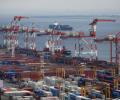
Barring rice, spices, iron ore and pharmaceuticals, all the remaining 26 key sectors registered negative growth in May. Imports too plunged 51 per cent to $22.2 billion in May.

For current financial year, govt plans to borrow Rs 2.88 trillion in the first half of 2018-19, out of Rs 6.05 trillion planned for entire year

If the current situation prevails, exports to China could fall by 10-15 per cent. Meanwhile, even the prices of cotton, of which Gujarat is one of the leading producers, have taken a hit.

Economy to grow 6.5% in 2016 on better macro conditions, says Mckinsey.
Reliance Industries Ltd on Friday reported a 15 per cent drop in its net profit to Rs 15,792 crore for the third quarter, according to a company's stock exchange filing. The net profit of Rs 15,792 crore in October-December 2022 compares to Rs 18,549 crore a year back.

The S&P BSE Sensex ended down 321 points at 23,089.

The latest hike is likely to be followed by another such move next month, said industry players. Before the latest hike, companies had initiated price hikes to the tune of 12-13 per cent in 2021 but they weren't able to fully cover the increase in costs.

It's time government used oil windfall wisely.
